
Quick answer
- Northern Hemisphere: March to October, best from May to July.
- Southern Hemisphere: February to October, best from April to August, when the core passes high overhead.
- Early in the season the core rises before dawn. Late in the season it is up after dusk.
- Best 2027 new moons: 6 May, 4 June, 4 July and 2 August.
1. Month by month (Northern Hemisphere, about 40°N)
Times are local standard time. Add an hour for daylight saving time. From 40°N, the core never climbs higher than about 21° above the southern horizon, so a low, clear southern view matters.
| Month | When the core is up | Dark time with the core above 10° |
|---|---|---|
| January–February | Only in twilight | None |
| March | Before dawn, low in the southeast | About 1½ hours |
| April | From about 3 a.m. | About 2 hours |
| May | From about 1 a.m., highest near dawn | About 3½ hours |
| June | Most of the night, highest around midnight | About 5 hours |
| July | From dusk, highest around 10 p.m. | About 4 hours |
| August | After dark, highest at nightfall | About 2½ hours |
| September | Evening, low in the southwest | About 1½ hours |
| October | Briefly after dusk | Under half an hour |
| November–December | Not visible in darkness | None |
Further north, the core sits lower and summer nights are shorter, so the season shrinks. Further south, it rises higher and the season grows.
2. Southern Hemisphere (about 35°S)
From Australia, South Africa, Chile and Argentina, the core climbs almost overhead. The season is longer, and the long winter nights in June and July give the core above 10° for 10 hours or more of darkness.
- February: before dawn, in the east.
- March to May: from the early morning to most of the night.
- June to August: high overhead for most of the night. The best months.
- September to October: in the evening, setting in the west.
3. The best 2027 dates
Pick a night within a few days of a new moon in the season:
| New moon (UTC) | North | South |
|---|---|---|
| 6 February | Too early | Before dawn |
| 8 March | Before dawn | Early morning |
| 6 April | Early morning | Most of the night |
| 6 May | After midnight | Most of the night |
| 4 June | Most of the night | All night |
| 4 July | From dusk | All night |
| 2 August | After dark | Most of the night |
| 31 August | Evening | Evening to midnight |
| 30 September | Early evening | Evening |
The full list is in new moon dates for 2026–2027.
4. Photographing it with an iPhone
- Go dark. The core shows clearly from Bortle class 4 or darker.
- Use the settings in the iPhone astrophotography guide: tripod, 1× lens, Night mode at Max, focus locked on a bright star.
- Shoot 10 to 30 frames without moving the phone.
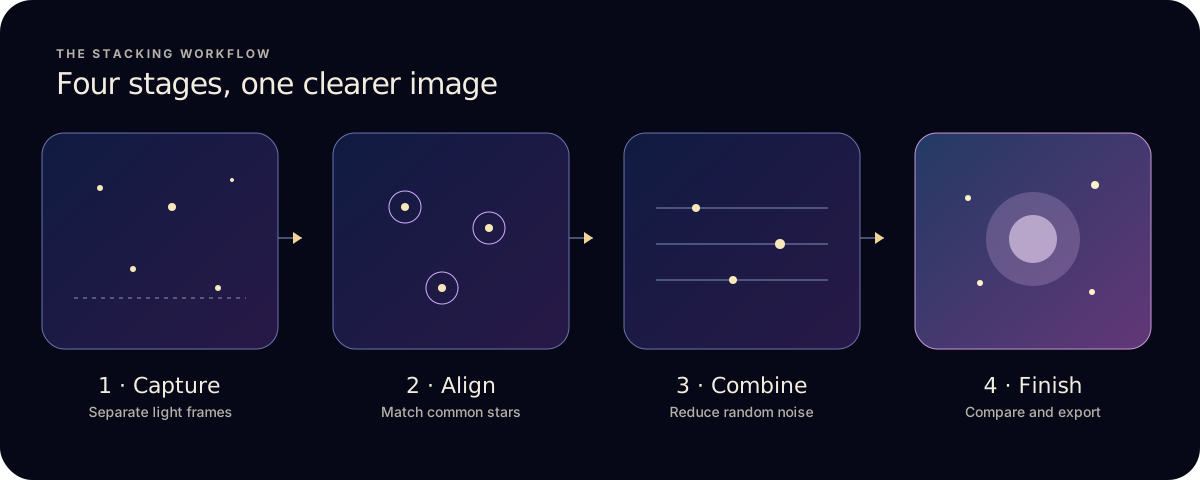
- Stack them. Astro Stacker aligns on the stars, so the sky stacks sharply. A foreground of trees or hills can smear slightly, because it doesn’t move with the stars.